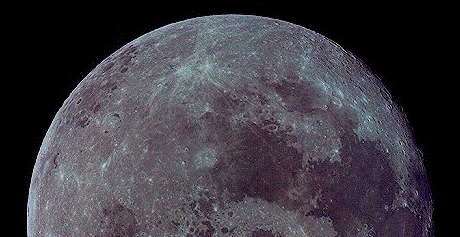
The Lunar Prospector was launched on 1998
January 6, and is NASA's first mission to the moon in 25 years. It will pick up
where Apollo and Clementine left
off.
Should we return to the moon? This is a
World Wide Web Public Policy Forum.
The Lunar
Exploration page of the National Space Science Data Center includes links to all lunar
missions.
The moon page at SEDS.
The Exploring the Moon page at Johnson SFC has lots
of information and images.
The Nine Planets
main page, and its set of images of the moon.
Exploring the moon
Want to know what phase the moon has
right now? Here it is!
A calculator showing the moon's phase
right now.
An animated gif showing the moon over one lunar
month (big download!).
The goal of Project Ranger was to crash land a TV camera on the moon, to see what the surface was like. Links are from JSC, NSSDC, GSFC, LANL, and JPL.
Lunar Orbiter mapped out the entire surface of the moon, discovered the mascons, and that the moon has no magnetic field. Pages are found at JSC, GSFC, and NSSDC. The Photographic Atlas of the Moon gives Lunar Orbiter pictures of almost the entire lunar surface.
The Surveyor program landed laboratories and TV cameras on the surface of the moon to investigate what the moon was made of, and find out whether people could work on the surface. Pages are found at JSC, and NSSDC.
Unmanned Space Project Management Surveyor and Lunar Orbiter is a NASA on-line history of both projects.
Project Mercury showed that people could work in space. This is the NASA page on the history of this project, and there are images too. The on-line book This New Ocean: A History of Project Mercury is NASA's official history.
Project Gemini showed that people could survive in space for a long time, and that it was possible for spacecraft to meet in orbit, and eventually dock together. Johnson has images. The on-line book On the Shoulders of Titans: A History of Project Gemini, is NASA's history.
The Apollo page at NASA page at NASA has lots of links to missions, images, videos, and sounds. Another complete summary is put together by Johnson SFC.
Official NASA books
The on-line book The
Apollo Spacecraft - A Chronology, is an NASA history.
Chariots for
Apollo: A History of Manned Lunar Spacecraft is NASA's history of the Apollo
spacecraft.
Moonport: A
History of Apollo Launch Facilities and Operations is NASA's history of its
launch centers.
Where No Man Has Gone Before: A History of Apollo
Lunar Exploration Missions is just that.
All of the major documents
that established Apollo are given here.
The mode decision, the most critical decision in the history of Apollo, is
discussed here.
Apollo over the moon - the
view from
orbit - beautiful pictures of the moon's surface taken from orbit
The Apollo Lunar Science
Journal includes complete voice transcripts from all six human lunar landings.
This NASA page gives the Press
Kits released for each Apollo mission.
The Project Apollo Archive, lots of multimedia files, and Contact Light, a retrospective.
The Apollo landing sites.
The NASA history office's home page.
Apollo: A Retrospective Analysis is a monograph commissioned by NASA summarizing Project Apollo.
The Top 10 things learned about the moon from Apollo.
Earth Station 1 has lots of sounds from Apollo 11.
The Apollo History is maintained by NASA Headquarters.
The real story behind the "Good luck Mr. Gorsky" comment in Apollo 11.
The National Air and Space Museum's Apollo page.
Here is a list of the top 10 technical errors or anachronisms in the Apollo 13 movie.
This is the official text of President Kenndey's Rice Speech, a talk he gave in their football stadium in September 1962. He went to dedicate what is now known as the Johnson Space Flight Center. This is still the only presidential speech dedicated to exploring space. If you have seen the video of this speech it is clear that he changed a lot as he went along. This page is dedicated to Kennedy, and has lots of audio files. Kennedy's comments on Nixon are hilarious.
Were the Apollo missions to the moon fakes? Fox says yes, the experts say no, no, no, no, no, and no.
