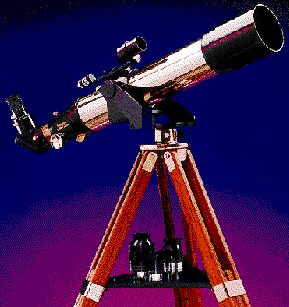
The Bluegrass Amateur Astronomy Club has a great page on buying telescopes, and would love to help out. See their page on buying telescopes. Lexington has a telescope dealer, Eric's Window to the Universe.
The purpose of an astronomical telescope is to gather light together, so that we can see things otherwise too faint to be seen. The objective of a telescope is the lens or mirror that does this. There are two ways to gather light - an objective lens (a refracting telescope) or an objective mirror (a reflecting telescope). Both can be found in any discount or toy store. A refracting telescope has fewer parts to align and so might be better for children. Most large telescopes, and all modern professional telescopes, are reflecting telescopes (called simply reflectors). Some expensive medium-sized telescopes use a combination of a lens and a mirror. In any case the more light it brings together the more you can see, so the idea is to go for the largest possible objective.
Magnification is the number of times closer or larger an object appears. The best way to check whether a telescope is really designed to be used is to check the advertised magnification - a good telescope will not claim large magnifications since it is impossible to use them from the surface of the Earth! The Earth's atmosphere "boils" (called convection) as heat moves through it. This motion causes astronomical seeing, which is a blurring of images, and it also causes stars to twinkle. Large magnification only magnifies this blurring. In practice magnifications larger than about 100x are of no use in a telescope. A good telescope will not quote any magnification in its advertising, and a toy that is impossible to use might claim magnifications of several hundreds.
This is the structure that hold the telescope up. This is a very important part of a telescope since it allows you to point it anywhere in the sky, holds the telescope still while you look at something, and maybe even helps correct for the spinning of the Earth (which is also magnified by the telescope). The mount should be very sturdy. A flimsy one will let the telescope move around it you touch it. It is very difficult to see anything without touching the telescope!
Your first hunch might be to go to a large discount store or toy store and buy the telescope with the largest magnification you can afford. This will almost certainly be a very frustrating mistake, since magnification only magnifies the blurring of the Earth's atmosphere, and the mounting for the telescope will probably be flimsy. Here is what I would suggest:
$100 to $200. In this price range the best bet would be a fine pair of binoculars. These can be used for sightseeing on trips, at sporting events, or when camping. The Milky Way, comets, and some star clusters are best viewed with binoculars. This is an excellent way to start. A pair of numbers something like 7x35 will be written somewhere on a pair of binoculars. The first number is the magnification. A good rule of thumb is that this should not be larger than about 7x if you intend to hold it in your hands, since you can't hold more magnification steady enough. The second number is a aperture of the objective lens. Bigger objectives will make it possible to see fainter things. The objective should be as big as possible, and will generally be about 5 times larger than the magnification.
$300-$500. Here there are two ways to go. The best bet for viewing very faint galaxies, nebulae, and comets would be the type of telescopes known as Dobsonians. They have very large objectives mirrors, very low magnifications, and simple but sturdy mounts. The name Dobsonian is not a brand name, they are named after their inventor. Several companies sell them. The second way to go might be a small compound telescope such as those made by Meade or Celestron.
More than $500. There are many choices here, and you probably can't go wrong. The big companies are Celestron, Meade, and Tele Vue.
Most do not sell directly to the public, but go through large camera stores. You can find lots of adds from national stores in the two astronomy magazines, Astronomy, and Sky and Telescope. These magazines are for sale at any large bookstore, like Joseph-Beths, but the nearest large discount camera store that would have a large line of telescopes is probably in Cincinnati or Louisville.
Meade
Celestron (310)328-9560
Tele Vue
Astronomy Mall has links to
lots of astronomy equipment for sale.
eHobbies has an astronomy page with lots
of information on buying telescopes